
Key Metrics for Evaluating Scientific Success

In the ever-evolving world of research, metrics play a critical role in assessing the impact and success of scientific contributions. With an increasing emphasis on data-driven evaluations, understanding key bibliometric indicators is essential for researchers, institutions, and policymakers alike. This blog explores the primary indices used to evaluate scientific success, demystifying their nuances and applications.
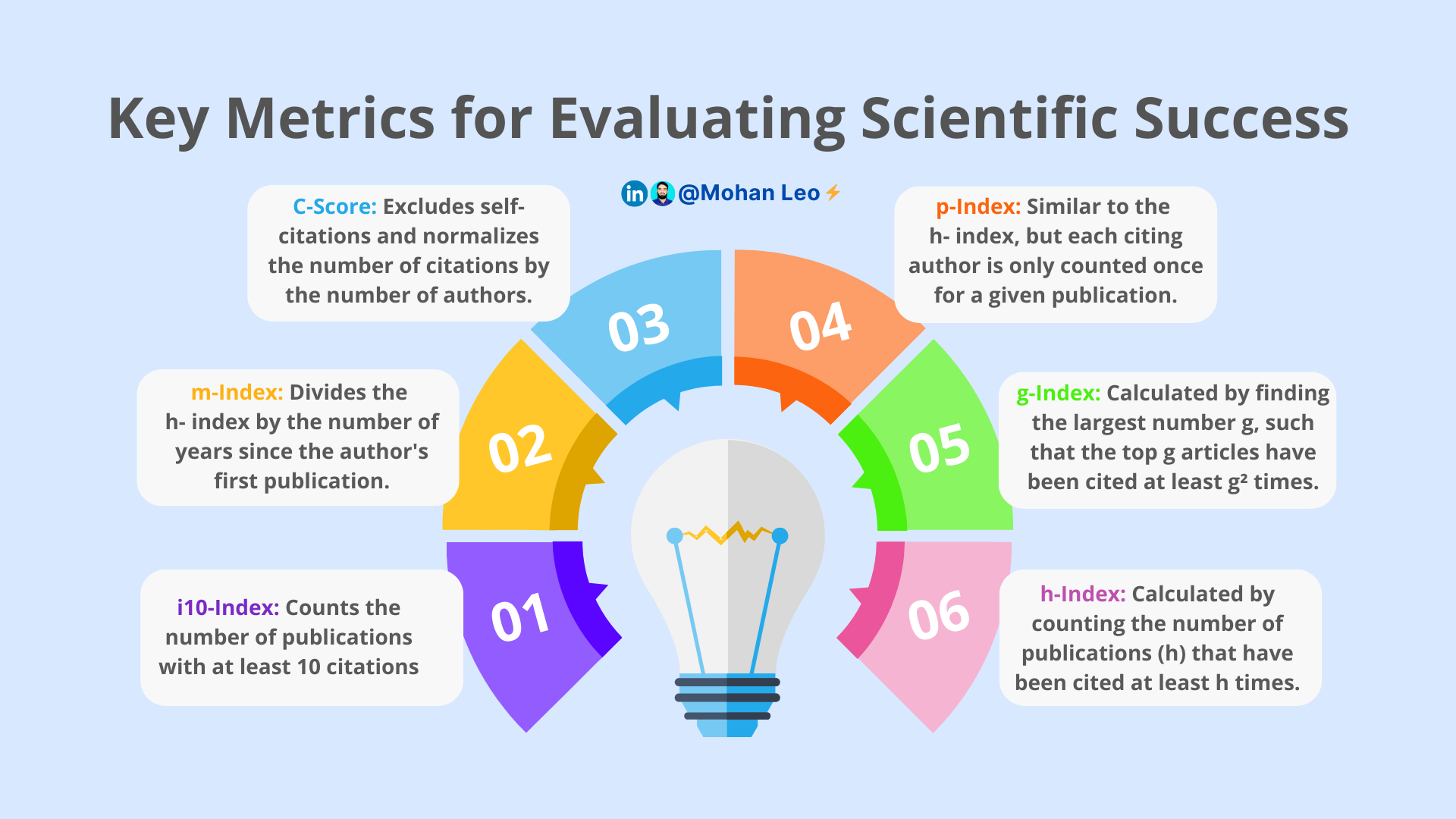
1. h-Index: The Benchmark of Citation Impact
The h-index, introduced by Jorge Hirsch in 2005, remains one of the most widely recognized metrics in academia. It measures both the productivity and citation impact of a researcher.
Definition: A researcher has an h-index of h if h of their N total papers have at least h citations each, and the other (N – h) papers have fewer than h citations.
Advantages: Balances quantity and quality by accounting for highly cited work.
Limitations: Favors established researchers with long careers, as early-career researchers often have lower h-indices.
Applications: Often used in hiring, tenure decisions, and funding evaluations.
2. g-Index: A Weighted Perspective on Citations
Leo Egghe introduced the g-index as an alternative to the h-index, addressing some of its limitations.
Definition: The g-index is the largest number g such that the top g articles received (cumulatively) at least g^2 citations.
Advantages: Gives more weight to highly cited papers, highlighting researchers with exceptional contributions.
Limitations: Can be skewed by a few outliers with very high citations.
Applications: Useful in fields with significant disparities in citation patterns.
3. i10-Index: A Simpler Citation Metric
Introduced by Google Scholar, the i10-index provides a straightforward measure of impactful work.
Definition: The i10-index counts the number of publications with at least ten citations each.
Advantages: Easy to calculate and understand; available through Google Scholar.
Limitations: Less detailed than other metrics and primarily limited to Google Scholar’s data.
Applications: Particularly useful for early-career researchers and quick evaluations.
4. m-Index: Normalizing for Career Length
The m-index addresses the career-length bias inherent in metrics like the h-index.
Definition: The m-index is the h-index divided by the number of years since the researcher’s first publication.
Advantages: Levels the playing field for early-career researchers by normalizing productivity over time.
Limitations: Relies heavily on accurate publication dates and may fluctuate with short-term citation changes.
Applications: Effective for comparing researchers at different career stages.
5. p-Index: A Personalized Approach
The p-index offers a nuanced, individualized assessment by focusing on a researcher’s most-cited work.
Definition: The p-index measures the average number of citations of the most-cited papers.
Advantages: Highlights a researcher’s peak impact without being diluted by lesser-cited work.
Limitations: Overlooks the breadth of a researcher’s contributions.
Applications: Ideal for identifying specialists with significant influence in a niche area.
6. C-Score: Collaboration and Contribution
The C-score evaluates a researcher’s contributions while factoring in collaborative efforts.
Definition: This metric assesses a researcher’s impact by distributing citation credit among co-authors proportionally.
Advantages: Recognizes collaborative efforts and prevents over-attribution in multi-authored papers.
Limitations: Can undervalue contributions in highly collaborative fields.
Applications: Useful for distinguishing individual impact within team-driven research.
Which Metric is Best?
There is no one-size-fits-all metric for evaluating scientific success. Each index has its unique strengths and limitations, making them suitable for different contexts:
For assessing overall productivity and impact: h-index and g-index.
For career stage normalization: m-index.
For quick assessments: i10-index.
For niche influence: p-index.
For collaborative environments: C-score.
In practice, a combination of these metrics often provides the most comprehensive picture of a researcher’s success. It is equally important to consider qualitative factors, such as the societal and practical impact of research, which quantitative metrics may overlook.
Conclusion
Understanding and leveraging bibliometric indices is crucial in today’s competitive academic landscape. By adopting a holistic approach that integrates multiple metrics, researchers and institutions can better navigate the complexities of scientific evaluation, fostering an environment that values both innovation and collaboration.